MatIntro week 3: derivatives, the mean value theorem and L'Hôpital
Solved exercises from week 3 of MatIntro at KU: the chain rule, differentiation from the definition, extrema on closed intervals, monotonicity and L'Hôpital's rule.
This post was AI-generated from handwritten notes in a notebook, digitised with a document scanner.
Course: MatIntro 2026, University of Copenhagen. Textbook: Tom Lindstrøm, Kalkulus. "TLO 6.1.1" means section 6.1, exercise 1.
Warm-up limits
Limit · Result · Method · · polynomials are continuous — insert · · denominator , so the quotient rule applies
TLO 5.4.3d
Direct substitution gives , so the denominator has to be factored first.
Pitfall: a fraction does not split term by term. ; only the numerator splits over a single denominator.
The chain rule
Peel from the outside in; each layer contributes one factor, and the inner expression stays unchanged inside the outer derivative.
TLO 6.1.1
· Function · Derivative d) · · , e) · · f) · ·
For f) the three layers are , and :
Layer · Function · Derivative, evaluated at the inner expression outer · · middle · · inner · ·
Pitfall: the inner derivative is a factor, not an afterthought. alone only differentiates the outer function.
Pitfall: , not . So .
Pitfall: means ; is the cosine of . Different functions.
Differentiation from the definition
TLO 6.1.10
Show from the definition. Multiply by the conjugate:
The conjugate is taken of whichever expression contains the roots — here the numerator. It is legal because the factor equals 1.
Pitfall: , not , and , not .
Pitfall: the denominator is a sum. Leave it factored as — cancelling against one term of a sum is not allowed.
TLO 6.1.12
for and for . Compute from the definition. Since is the boundary between the branches, the difference quotient splits by the sign of , with :
Both one-sided limits are , so .
Pitfall: is two-sided. Computing only gives the right-hand derivative. For at that would give while the left side gives , and does not exist (TLO 6.1.11a).
Pitfall: at a boundary point the differentiation rules cannot be applied to one branch alone — the exercise asks for the definition for a reason.
TLO 6.1.5 — the differential as an estimate
A cylindrical concrete pipe is m long with inner radius m and cement thickness m. With and , the cement is the shell between and :
The estimate is about 5 % low; the difference is the term of order that theorem 6.1.7 drops.
Pitfall: is the hollow interior, not the cement. The cement is the difference between two volumes.
Extrema on a closed interval
The extreme value theorem guarantees a maximum and a minimum on . The candidates are:
- critical points, where ;
- points where does not exist;
- the endpoints and .
Evaluate at all candidates and compare. The largest value is the global maximum on that interval.
TLO 6.4.1a
on . From , divide by 6: , so or , both inside the interval.
Maximum at , minimum at .
Pitfall: don't factor out when there is a constant term — does not become usefully. Divide by 6 and use the quadratic formula.
TLO 6.4.1d
on . The product rule gives
is never , so the zeros are and ; only is in the interval.
Maximum at the endpoint , minimum at .
Pitfall: is a sum, so the zero-product rule does not apply to it directly. Factor first: .
Pitfall: means a horizontal tangent, not that is zero. A critical point is a candidate, nothing more.
TLO 6.4.2b
on . gives , so , inside the interval.
Minimum at , maximum at .
Pitfall: no calculator is needed to solve — apply to both sides. And keep the values exact; and are close enough to swap if you round first.
TLO 6.4.2c
on . With :
Minimum at , maximum at the endpoint .
Pitfall: , so is not a critical point. And a constant factor survives differentiation: .
TLO 6.4.2e
on . Split at the kink:
Neither branch has a zero inside its own range, so the candidates are (where does not exist) and the endpoints.
Minimum at , maximum at .
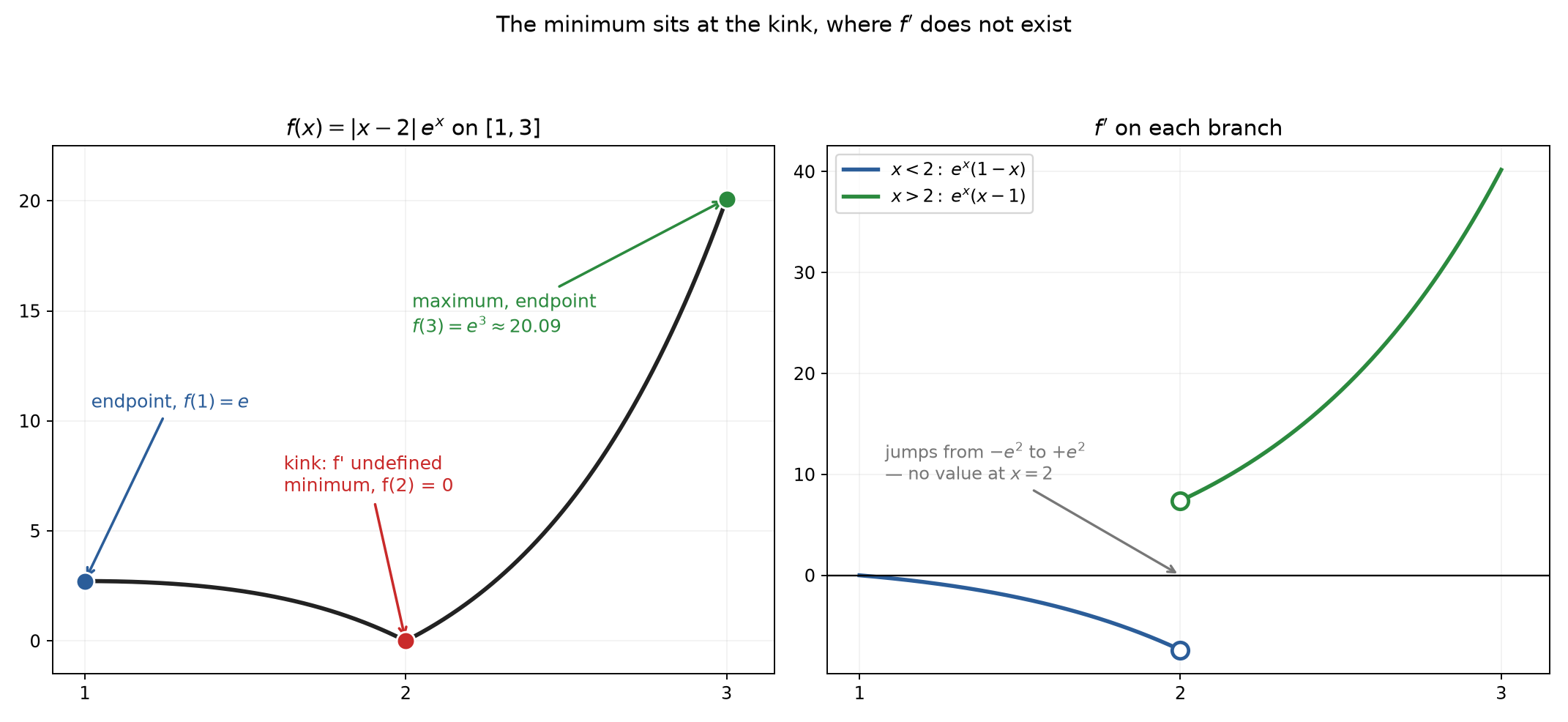
Pitfall: the minimum can never show up from , because does not exist — the left branch arrives with slope and the right leaves with . That says nothing about whether extrema exist.
Increasing and decreasing
Corollary 6.2.5: on an interval means strictly increasing, means strictly decreasing. It follows from the mean value theorem.
TLO 6.2.1a
, : decreasing for , increasing for .
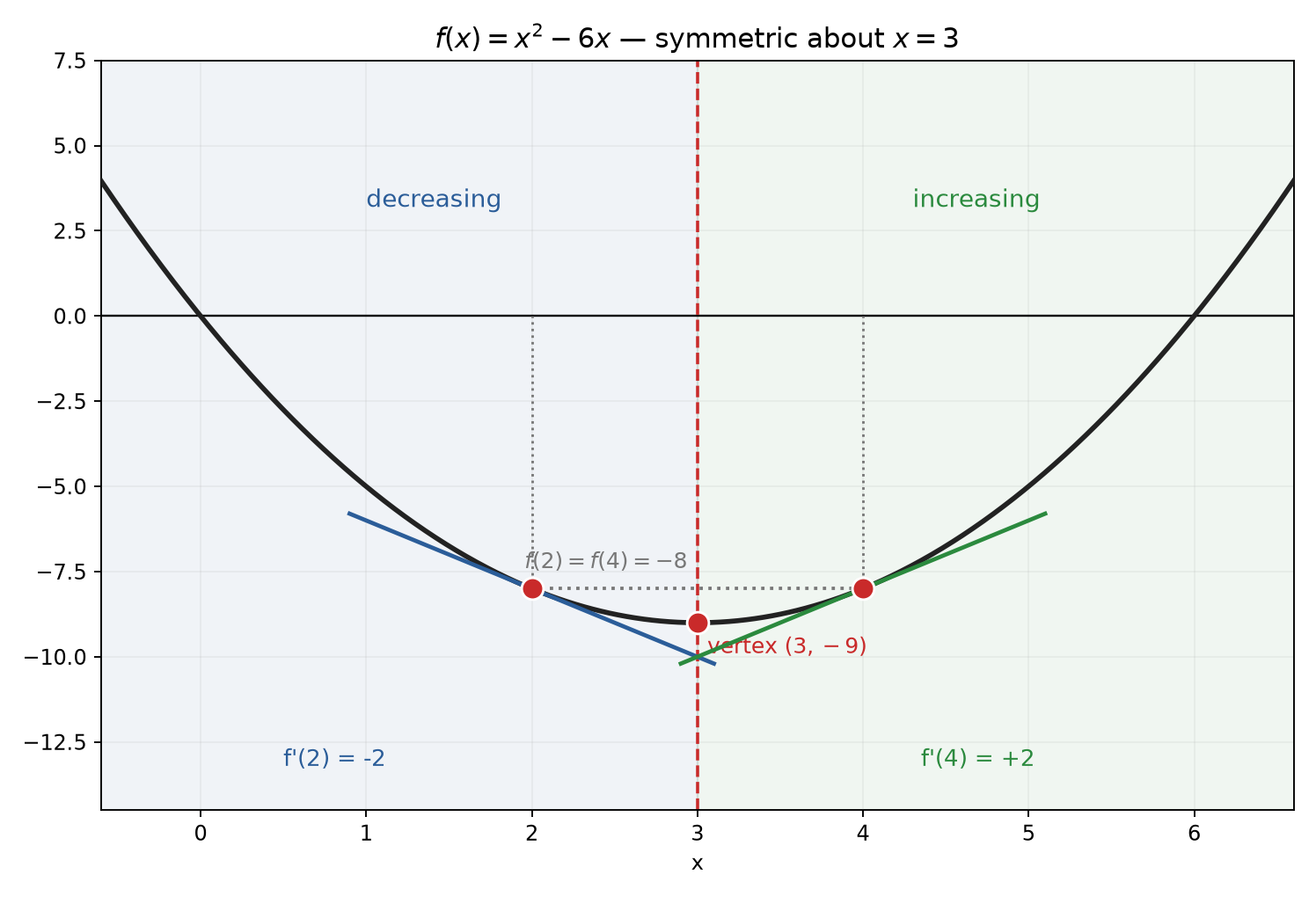
Pitfall: is not a contradiction. Increasing and decreasing describe the slope, not the value — and . The parabola is symmetric about its vertex, so points equally far from share a value.
TLO 6.2.1c
with , so . The factor vanishes at ; for the other one substitute :
Since and is already too large, only survives, giving two points .
Test point · · · ·
Interval · · · · · increasing · decreasing · increasing · decreasing
Pitfall: is zero every , not every .
Pitfall: gives . The stays under the root; it is not squared.
Pitfall: test inside each interval. At the dividing points is by construction, so those values carry no information. And is a dividing point too — forgetting it merges two intervals with opposite behaviour.
Pitfall: the calculator must be in radians. is the tell-tale sign that it isn't.
TLO 6.2.2a — exactly one zero
Show that has exactly one zero in . Two halves:
At least one — the intermediate value theorem (5.2.1) needs the function values at the endpoints to have opposite signs:
No calculator needed for the second: gives , and gives .
At most one — on the interval, so is strictly decreasing. Two zeros would mean , contradicting strict monotonicity.
Pitfall: the endpoints used must belong to the interval. Testing at instead of locates a zero in , which is a different claim.
Pitfall: solving algebraically is not possible — that is exactly why the two theorems are used instead.
L'Hôpital's rule
Differentiate numerator and denominator separately, not with the quotient rule, and only when the form is indeterminate:
Exercise · Limit · Result TLO 6.3.1d · · TLO 6.3.1g · · TLO 6.3.1h · · TLO 6.3.2b · ·
In d) the denominator differentiates to , so the rule gives .
In g) the rule is applied three times, and each application needs the form to still be :
Pitfall: , not .
Pitfall: stop when the form stops being indeterminate. In h) the second application gives , which is simply .
Pitfall: L'Hôpital is not a way around dividing by zero — it compares how fast numerator and denominator approach their limits, which is why the proof rests on the mean value theorem.
Quotient rule
Pitfall: differentiating numerator and denominator separately is L'Hôpital, not differentiation. The quotient rule is .
Pitfall: after factoring, the bracket collapses to — but the denominator stays as and cannot be cancelled against .
Theorems used this week
6.1.5    chain rule
6.1.7    f(a+h) = f(a) + f'(a)h + η(h)h  — the differential
6.1.9    differentiable ⟹ continuous
6.2.1    interior extremum + differentiable ⟹ f'(c) = 0
6.2.2    Rolle's theorem
6.2.3    mean value theorem
6.2.5    sign of f' ⟹ increasing / decreasing
6.3.x    L'Hôpital's rule
6.4.2    local extremum: endpoint, f'(c) = 0, or f' undefined
The intermediate value theorem (5.2.1) and the mean value theorem (6.2.3) are different statements: the first is about values and needs only continuity, the second is about slope and needs differentiability. They get used together — one gives existence of a zero, the other uniqueness.