MatIntro week 4: integration techniques and differential equations
Solved exercises from week 4 of MatIntro at KU — the integral as squeezed step sums, the fundamental theorem, integration by parts and substitution, and three kinds of differential equations.
This post was AI-generated from handwritten notes in a notebook, digitised with a document scanner.
Course: MatIntro 2026, University of Copenhagen. Textbook: Tom Lindstrøm, Kalkulus. "TLO 9.1.1" means section 9.1, exercise 1.
The integral as squeezed step sums
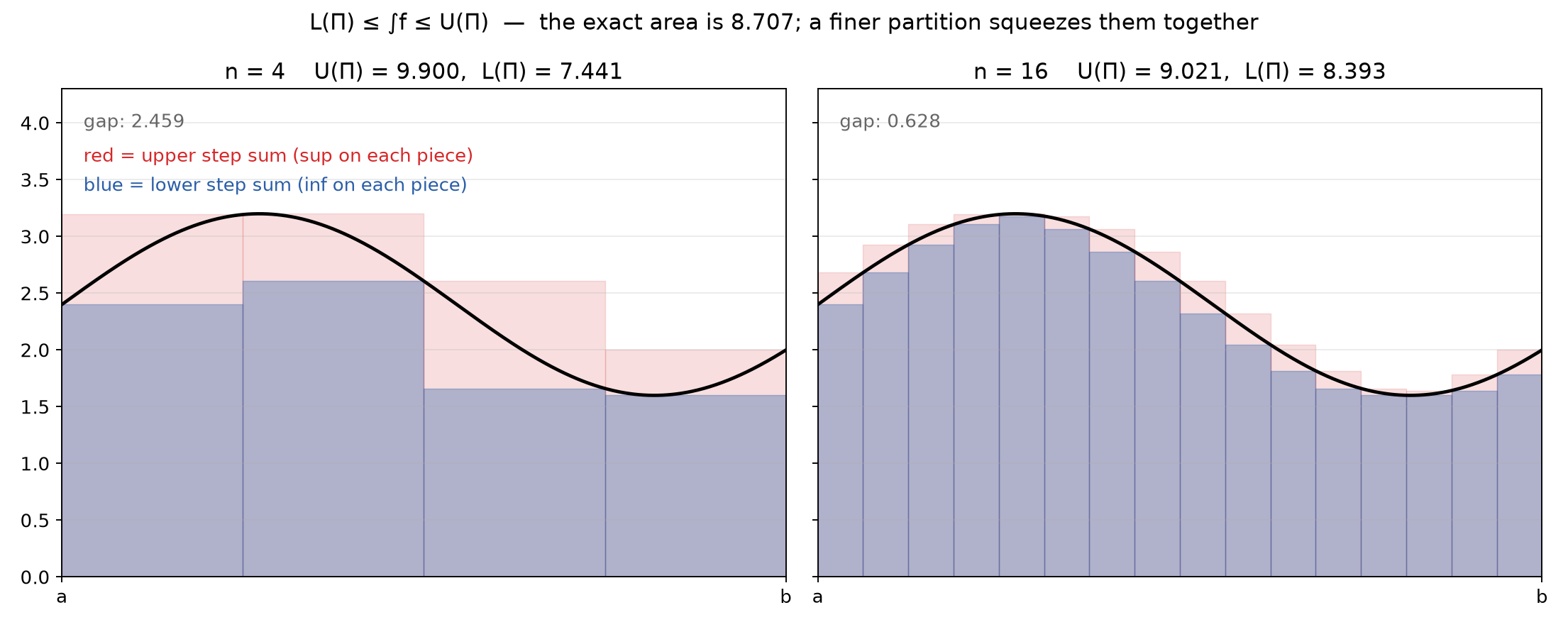
Split into pieces. On each piece, a rectangle as tall as the supremum of gives the upper step sum ; one as tall as the infimum gives the lower step sum . Every partition satisfies
and refining the partition can only push the two together. is integrable when the best upper bound and the best lower bound meet — the upper and lower integrals are equal.
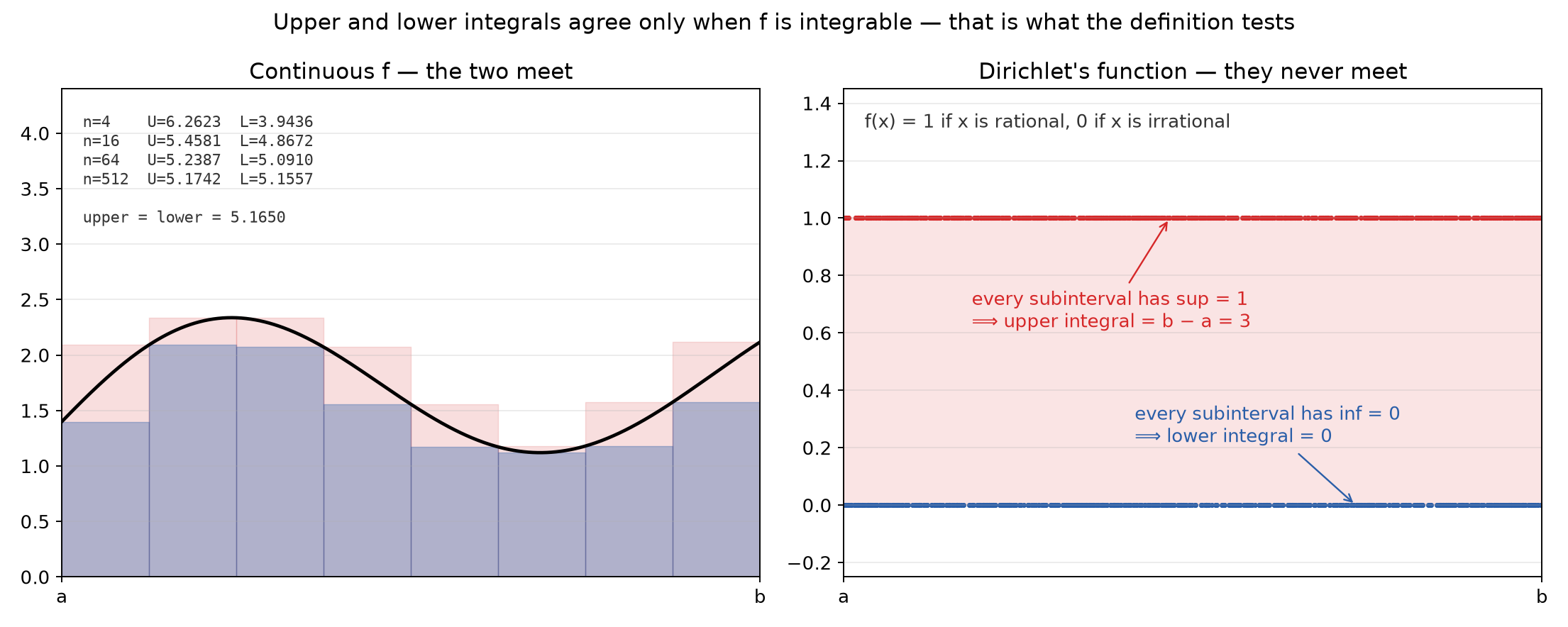
The definition is not a formality. Dirichlet's function — on the rationals, on the irrationals — has a rational and an irrational number in every subinterval, so every upper sum is and every lower sum is . The two never meet, and the function has no integral.
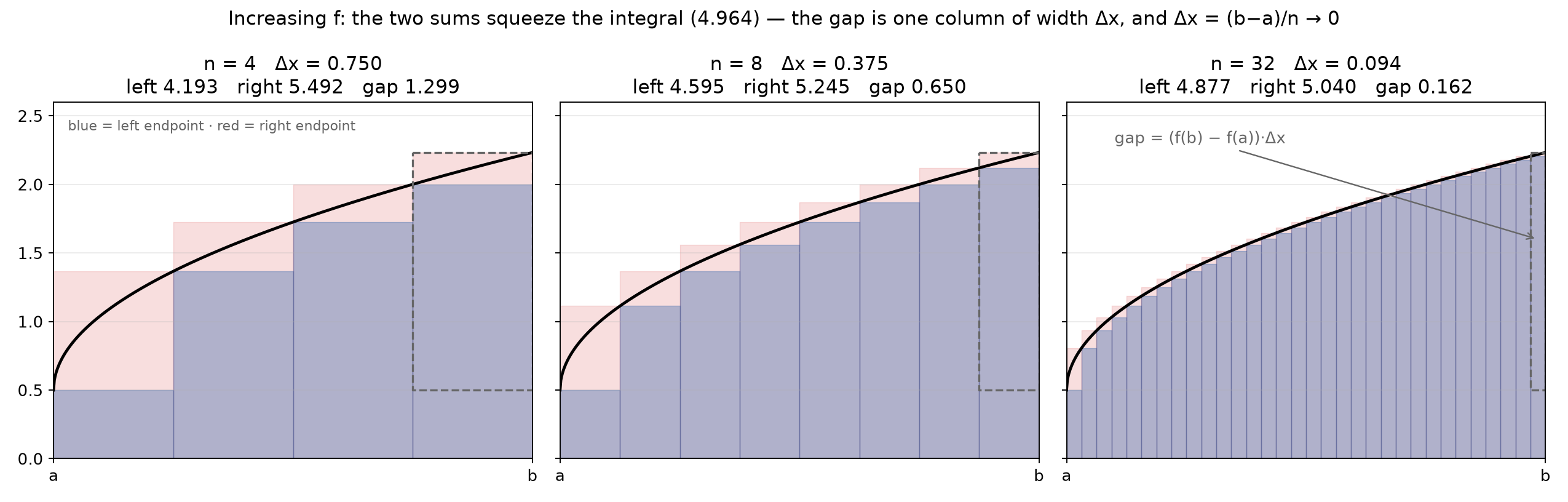
For an increasing function the argument is short: the sup on each piece sits at its right endpoint and the inf at its left, so the difference between the two sums telescopes to a single column,
The fundamental theorem
If is continuous, the area function is differentiable with . Combined with the chain rule, that handles variable limits:
· Function · Derivative Integral 1 · · Integral 2 · · Integral 3 · ·
Pitfall: is evaluated at , so the chain rule adds a factor , and becomes — not .
Pitfall: is the square of an integral, not the integral of a square. The outer layer is , which differentiates to times the inner derivative .
Standard integrals
Read the table left to right: find the integrand on the left, the antiderivative is on the right. Read right to left, it is a table of derivatives.
(constant) · , ·
A scaled argument divides by the scale: , so . Roots and reciprocals become powers first: and .
Integration by parts
Let be the factor that gets simpler when differentiated (, ), and the one that does not get worse when integrated (, , ).
TLO 9.1.1
· Integral · Choice · Result a) · · , · b) · · , · c) · · , · d) · · , , twice ·
Pitfall: in a) the first attempt took and . But must be the integrand — that choice integrates , not . Check the product before applying the formula.
Pitfall: in c), gives , not . Differentiate to check.
The trick is useful elsewhere, though: for take , , so and
For one application lowers the power by one, which gives a recursion formula:
Pitfall: the factor multiplies the whole previous integral. Writing drops the and gets the sign of the last term wrong — the minus in front of flips the minus inside it.
Exercise A1
Three rounds with and each time:
Check by differentiating: .
Pitfall: means — in every round. The went missing four times along the way. Differentiating gives , so the is needed to cancel the chain rule's .
Substitution
For a definite integral the limits move with it: . Look for an inner function whose derivative stands (almost) next to it as a factor.
Exercise A2
gives , so . The limits become and :
Pitfall: after substituting, no may remain. A first attempt rewrote back into and ended with both and in the same integral.
Pitfall: the new limits come from plugging into : and , not and .
Pitfall: the power rule holds for fractional and negative exponents too — add one to the exponent and divide by the new one. Only is the exception.
Pitfall: . The slip was ; it is .
Exercise A3
With , and . The limits stay and , and the integral is A1 again with a different variable name: .
TLO 9.2.1a
TLO 9.2.3a
Pitfall: differentiate , don't copy it. The first attempt on paper had ; it is .
Pitfall: the upper limit turned into on paper. Once the integral is in , the limits are -values: and .
Pitfall: leave the answer as . The MC exam has no calculator and lists exact answers.
TLO 9.2.3b
A function and its derivative appear as factors, which is the signal to substitute.
Pitfall: is the function whose derivative is present, not the derivative itself. Choosing gives , and is nowhere to be found.
Pitfall: is not . is the same computation as .
Linear first-order equations
Write the equation as — with a plus, so a minus belongs to . With an antiderivative of , theorem 10.1.3 gives all solutions:
The idea behind it: multiplying by turns the left side into the product rule written out, .
TLO 10.1.1 — is it a solution?
· Candidate · Equation · Check · Solution? a) · · · · yes b) · · · · yes c) · · · · no
TLO 10.1.3b
, , integrating factor :
Pitfall: the sign belongs to . is .
Pitfall: simplify before integrating. . An attempt to integrate by substitution stalled — that integral has no elementary antiderivative, and it never had to be computed.
TLO 10.3.1
This is linear, not separable: is a sum and cannot be written as . With and :
gives , so .
Pitfall: is an *anti*derivative of , found by integrating: .
Pitfall: is the right-hand side, — and the goes inside the bracket, before multiplying by .
Separable equations
Rewrite as — everything with and on the left, everything with on the right. Then
This is substitution with : becomes . That only works if stands as a factor in the numerator on the -side.
TLO 10.4.1a
TLO 10.4.1c
is also a solution; it is lost when dividing by .
Pitfall: don't divide by . The first attempt, , separates the variables but leaves in a denominator, where cannot become .
Pitfall: is not — is the exception, and the answer is .
Pitfall: . Take the reciprocal of the whole side at once.
TLO 10.4.2a
The book only has answers for odd exercises, so check by substituting: , and .
Pitfall: integrate, don't differentiate. The first guess was , which is the derivative.
TLO 10.4.2b
gives . Divide by and square:
Check: gives .
Pitfall: is not ; is only for exactly . Write first and use the power rule: .
Pitfall: divide every term by , including — and , not .
Pitfall: square the whole side as one bracket. ; doing it term by term gave , which fails the check at .
Second-order homogeneous equations
For , solve the characteristic equation . The discriminant decides the form (theorem 10.5.14):
Roots · Discriminant · All solutions two real, · · one double root · · complex, · ·
With initial conditions and there is exactly one solution; they fix and .
Exercise · Equation · Roots · Solution TLO 10.5.1a · · · TLO 10.5.1c · · (double) · TLO 10.5.1d · · · TLO 10.5.3a · , , · · TLO 10.5.3b · , , · · TLO 10.5.3d · , , · ·
In 10.5.3a the conditions give and , so and .
Pitfall: a double root needs the on the second term. Without it the two terms are the same function and a solution is missing. This one cost points on a past MC exam (MC1-2023C, H).
Pitfall: check the sign of the root. has root , not .
Tip: for complex roots take positive. gives , ; a minus on is absorbed into , since .
Tip: for the MC question "which function is a solution?", find the roots, write the general form, and pick the option that can be written in that form — is , for the double root .
Theorems used this week
8.2–8.3   upper and lower step sums, integrability
8.4.3     ∫ f(ax) dx = F(ax)/a + C
9.1       integration by parts
9.2.1     substitution;  9.2.7  new limits for definite integrals
10.1.3    linear first order:  y = e^(−F) (∫ e^F g dx + C)
10.4      separation of variables
10.5.14   second order, constant coefficients — three cases
The fundamental theorem links the two halves of the week. Integration by parts and substitution are the product rule and the chain rule read backwards, and both solution methods for first-order equations are those two techniques in disguise.