MatIntro week 5: Taylor polynomials and the remainder term
Solved exercises from week 5 of MatIntro at KU — differential equations on repeat before the first MC exam, Taylor polynomials, and using the remainder term to control errors and compute limits.
This post was AI-generated from handwritten notes in a notebook, digitised with a document scanner.
Course: MatIntro 2026, University of Copenhagen. Textbook: Tom Lindstrøm, Kalkulus. "TLO 11.2.4" means section 11.2, exercise 4.
Differential equations
Exercise · Equation · Solution TLO 10.1.3c · · TLO 10.1.3e · · TLO 10.4.1e · · , and TLO 10.5.1b · · TLO 10.5.1f · · TLO 10.5.2a · · TLO 10.5.2b · ·
In 10.1.3c, , and :
Pitfall: is an antiderivative of . On paper it was labelled ; the value was right but the name was wrong, and that kind of slip turns into differentiating instead of integrating next time.
Pitfall: multiply out at the end. — the exponentials cancel, and that constant is the equilibrium the solution settles at.
In 10.4.1e, separate and integrate:
then divide by and square. The notebook stopped at — the last two steps are the ones that went wrong in TLO 10.4.2b last week.
Pitfall: , with a negative exponent. It was written on paper; the answer came out right anyway, but only because the next line used the correct rule.
Taylor polynomials
The Taylor polynomial of degree about is the polynomial that agrees with in value and in the first derivatives at :
Pitfall: it is . Copying the formula with from an example about breaks every exercise about another point.
TLO 11.1.1
Degree 4 for about . The derivatives get long quickly — each one needs the product rule and the chain rule:
Pitfall: the first attempt got and — terms dropped from the product rule. A quick sanity check: is even, so every odd derivative at must be , and an term can't appear.
Tip: substitute instead of differentiating. , and gives immediately.
TLO 11.1.9 and 11.1.10
, degree 3.
About , the Taylor polynomial of a polynomial is just the polynomial with the high powers cut off: .
About :
Pitfall: keep the powers of . A detour on paper replaced with — mixing up the derivative with the term. The coefficients are numbers; only carries the variable.
Taylor's formula with remainder
The remainder is defined as what the polynomial misses (p. 652):
So the error made by using instead of is — not , which is always exactly .
Theorem 11.2.1 gives an exact formula for it, if — the function and all of its first derivatives — are continuous:
The integral can rarely be computed, but it can be bounded. Corollary 11.2.2: if for all between and , then
Lagrange's form (11.2.3) says the remainder looks just like the next term of the polynomial, except the derivative is evaluated at an unknown strictly between and :
depends on , and it is never needed explicitly — only a bound on over the interval.
TLO 11.2.2
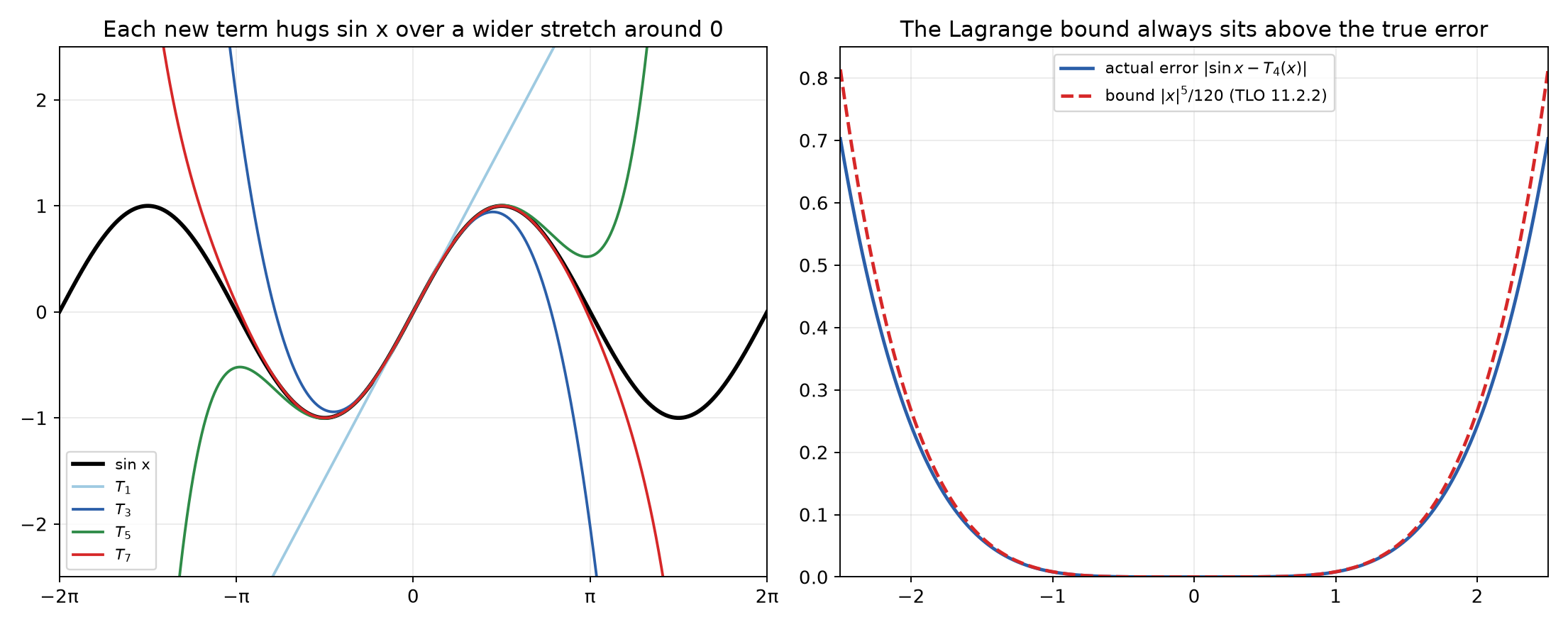
Degree 4 for about , and show .
The term vanishes because , so the polynomial looks like degree 3 but is . With , Lagrange needs :
since whatever is.
Pitfall: write it with absolute values. can be negative and so can ; "cos only pulls the value down" is the right idea, but the inequality is between absolute values.
Pitfall: the bound holds for every , but for it says — true and useless. Taylor polynomials are good near .
TLO 11.2.4
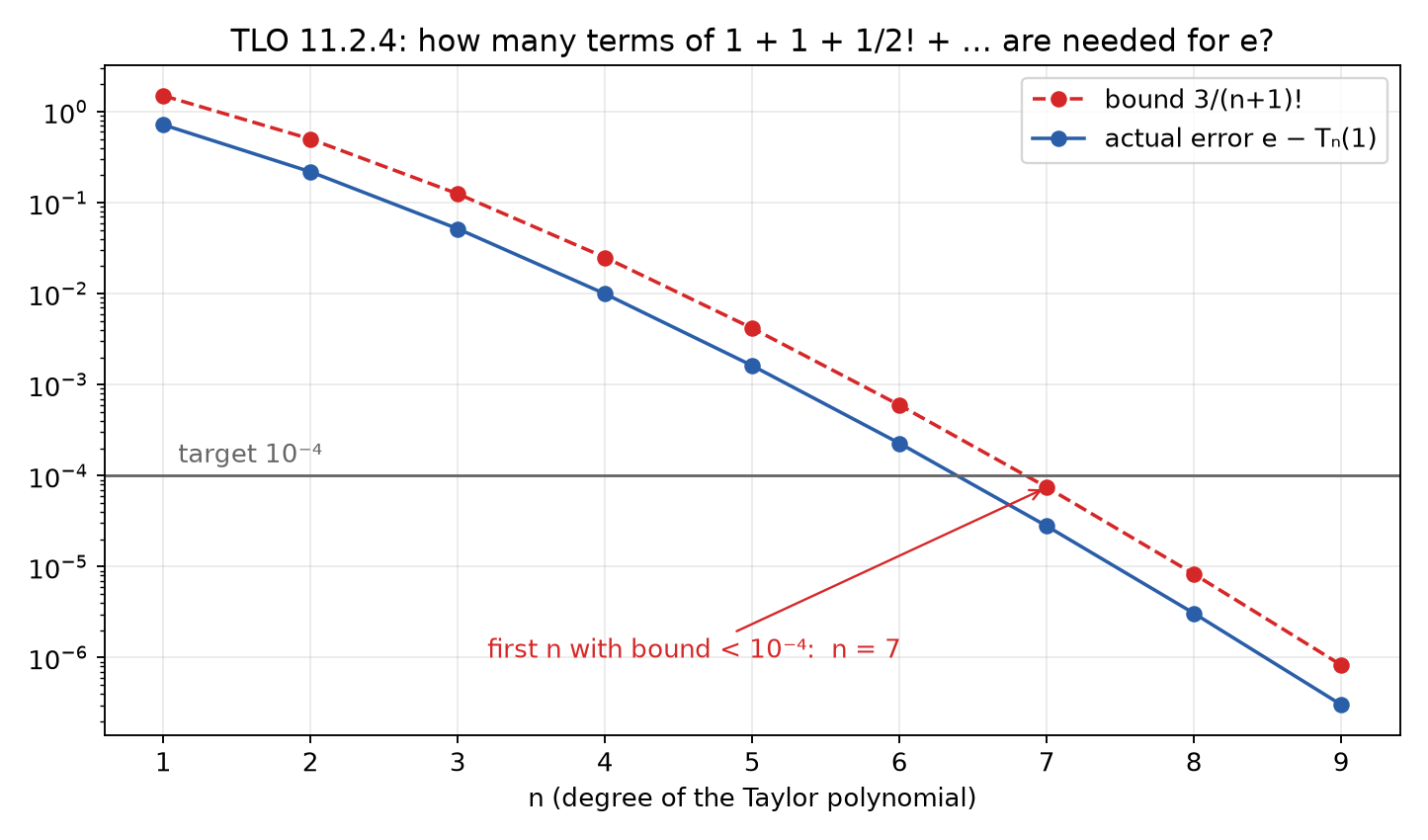
Compute with an error below , given . This is evaluated at , about . Both formulas are used, in this order:
- The remainder decides how many terms are needed.
- The Taylor polynomial gives the number.
Every derivative of is , which is increasing, so on it is at most . That makes , and corollary 11.2.2 gives
This holds automatically. What we require is that the bound is below the target:
Multiplying both sides by keeps the inequality, since both are positive. is too small and is enough, so and .
Every coefficient is , and at — that is why disappears from the fractions:
The true value is , so the actual error is about .
Pitfall: and are two different bounds. caps the derivative ; caps the error . The corollary is what links them.
Example 11.2.5 — the error of an integral
The book computes to within , an integral that cannot be done by hand. Divide by and integrate:
The quantity that must be below is the integral of the remainder, not the remainder itself. The pointwise bound is only a step on the way: divide by , integrate, and require . That first happens at , and the answer is .
TLO 11.2.7
Direct substitution gives . Only is not a polynomial, so it is the part to replace. How far to go? The remainder will be divided by , so it must be of higher order than . gives a remainder of order :
since .
Pitfall: is already a polynomial; its Taylor polynomial is itself, so there is nothing to gain there.
Pitfall: is too small. cancels the and leaves only the remainder over — the limit can't be read off.
Pitfall: the remainder needs a strictly higher power than the denominator, not the same one.
Pitfall: it is , not . lies strictly between and , so the remainder is not — it just vanishes in the limit.
Pitfall: , with in the denominator, not .
The same limit came out of L'Hôpital's rule three times in week 3 (TLO 6.3.1g). With Taylor it is one expansion and no repeated differentiation:
Read next: MatIntro week 3: derivatives, the mean value theorem and L'Hôpital — TLO 6.3.1g: the same limit with L'Hôpital
TLO 11.2.8
The same recipe about . Differentiate by writing each derivative as a power, :
0 · · 1 · · 2 · · 3 · · 4 · · —
In the numerator, and cancel against the polynomial, leaving
As , is squeezed between and , so stays bounded and the second term goes to .
Pitfall: only the first term is . The others use the derivatives at , and none of those is .
Pitfall: , not . Only the power of moves below the fraction bar; the coefficient stays on top.
Pitfall: the last coefficient is .
Pitfall: don't expand the polynomial. Kept in powers of , it lines up term by term with the numerator and the denominator, and the cancellation is visible at a glance.
Theorems used this week
11.1     Taylor polynomial  T_n f(x) = Σ f⁽ᵏ⁾(a)/k! · (x−a)ᵏ
11.2.1   Taylor's formula:  R_n f(x) = (1/n!) ∫ₐˣ f⁽ⁿ⁺¹⁾(t)(x−t)ⁿ dt
11.2.2   |f⁽ⁿ⁺¹⁾| ≤ M  ⟹  |R_n f(x)| ≤ M/(n+1)! · |x−a|ⁿ⁺¹
11.2.3   Lagrange:  R_n f(x) = f⁽ⁿ⁺¹⁾(c)/(n+1)! · (x−a)ⁿ⁺¹
The remainder does two jobs this week. With a target error, it tells you how many terms to take. In a limit, it is the piece that vanishes, and the polynomial carries the answer.